
Banks process millions of transactions every day across mobile banking, cards, ATMs, digital wallets, online banking, and payment platforms. Behind this enormous volume of activity is a critical challenge: identifying fraudulent transactions quickly without disrupting legitimate customers.
Traditional fraud detection systems rely heavily on predefined rules, statistical models, and machine learning algorithms trained on historical data. These approaches remain important, but modern fraud is becoming increasingly sophisticated. Fraudsters continuously change their tactics, combine multiple attack vectors, and exploit gaps between systems.
A transaction that appears normal in isolation may become highly suspicious when viewed alongside a customer’s login behavior, device information, location, transaction history, and recent activity.
This creates an opportunity for a new approach to fraud detection, one that doesn’t simply identify anomalies but can also investigate, reason, and support decisions in real time.
This is where Agentic AI can make a difference.
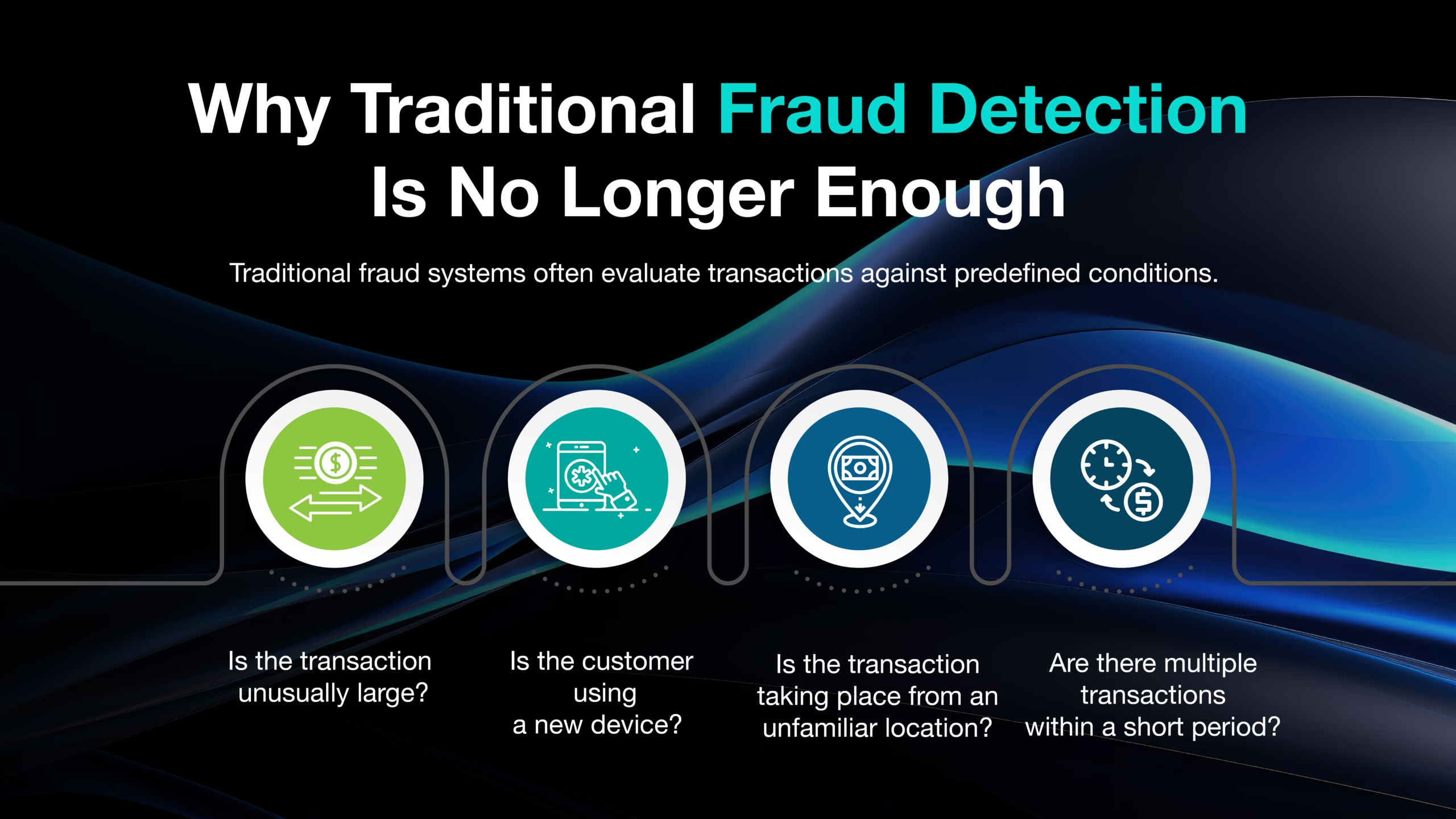
These signals are useful, but fraud rarely depends on a single signal.
Consider a customer who normally makes small domestic transactions. Suddenly, the account experiences multiple failed login attempts, a login from a new device and location, followed by a high-value transfer.
Individually, these events may not always trigger a decisive response. Together, they can represent a significant risk.
The challenge is therefore not just detecting unusual activity. It is connecting different signals, understanding their context, investigating the situation, and determining what action should happen next.
Moving From Detection to Investigation
Agentic AI introduces a different way of approaching this problem.
Instead of using AI only as a prediction engine, organizations can build an ecosystem of specialized AI agents that work together across the fraud detection process.
These agents can gather information from multiple systems, monitor transactions, analyze behavioral patterns, investigate suspicious activity, assess risk, and support fraud analysts.
The result is a more contextual and dynamic approach to fraud prevention.
Bringing the Full Customer Context Together
Effective fraud detection begins with having the right information.
Transaction systems contain payment details. Customer platforms contain account history. Authentication systems capture login behavior, while device and location systems provide additional context. Historical fraud investigations can provide another valuable source of intelligence.
An AI-driven data aggregation layer can bring these signals together in near real time.
Rather than evaluating a transaction independently, the system can understand it within the broader context of the customer’s behavior.
This enables AI to identify relationships between events that may otherwise remain hidden across separate systems.
Detecting Suspicious Behavior in Real Time
Once relevant information is available, AI can continuously monitor incoming transactions and account activity.
Machine learning and anomaly detection models can identify deviations from established behavioral patterns, including unusual transaction amounts, unexpected geographic activity, new devices, abnormal transaction frequency, or changes in account behavior.
The real value comes from combining these signals.
A high-value transaction may not necessarily be fraudulent. A new device may not be suspicious on its own. But when a high-value transfer occurs from a new device immediately after several failed login attempts, the combined context can significantly change the risk assessment.
This moves fraud detection from simple rule matching toward context-aware risk analysis.
When AI Doesn’t Just Detect—It Investigates
Detection is only the beginning.
When suspicious activity is identified, AI can help investigate the event by automatically gathering relevant information.
It can review recent transactions, customer history, device activity, geographic patterns, related transactions, and previous fraud cases.
Instead of presenting fraud analysts with disconnected alerts, the system can create a consolidated picture of the incident.
For example, rather than simply reporting:
“High-risk transaction detected.”
the system could explain that the transaction is significantly above the customer’s normal range, originated from a newly observed device, followed multiple failed authentication attempts, and shares characteristics with previously identified fraud patterns.
That context can help analysts understand why the transaction is considered risky and determine what action may be appropriate.
Explainable Risk Scoring
Another important capability is dynamic risk scoring.
Transactions or account activities can be classified based on their overall risk:
- Low Risk: Allow
- Medium Risk: Review
- High Risk: Hold, block, or escalate
However, a risk score alone is not enough.
Fraud teams need to understand the factors contributing to that score. Agentic AI can provide explanations based on relevant evidence, such as unusual transaction amounts, new devices, geographic changes, authentication failures, transaction velocity, or similarities to known fraud patterns.
This creates a more transparent decision-support process and enables investigators to focus their attention where it matters most.
Keeping Humans in the Loop
Banking fraud is a high-impact area where human oversight remains essential.
Agentic AI can support fraud analysts rather than simply replacing them. Medium-risk and high-impact cases can be routed to analysts along with investigation summaries, relevant evidence, risk factors, and recommended next steps.
Analysts can approve a transaction, place it on hold, block it, escalate the case, or override the AI recommendation.
Their decisions can also become valuable feedback for improving future detection.
This creates a continuous relationship between AI-driven intelligence and human expertise.
Learning as Fraud Evolves
One of the biggest challenges in fraud prevention is that yesterday’s patterns may not represent tomorrow’s threats.
Fraudsters constantly adapt. They discover new vulnerabilities, change transaction patterns, use new devices, and develop methods designed to bypass existing detection mechanisms.
An adaptive AI architecture can learn from confirmed fraud cases, false positives, analyst decisions, changing customer behavior, and emerging transaction patterns.
Over time, this can help organizations refine their models and detection strategies to respond to evolving threats.
Building the Next Generation of Fraud Operations
The future of fraud detection is unlikely to depend on a single model or a collection of static rules.
It will increasingly require systems capable of understanding context, behavior, relationships, and risk across multiple data sources.
Agentic AI provides a foundation for that evolution.
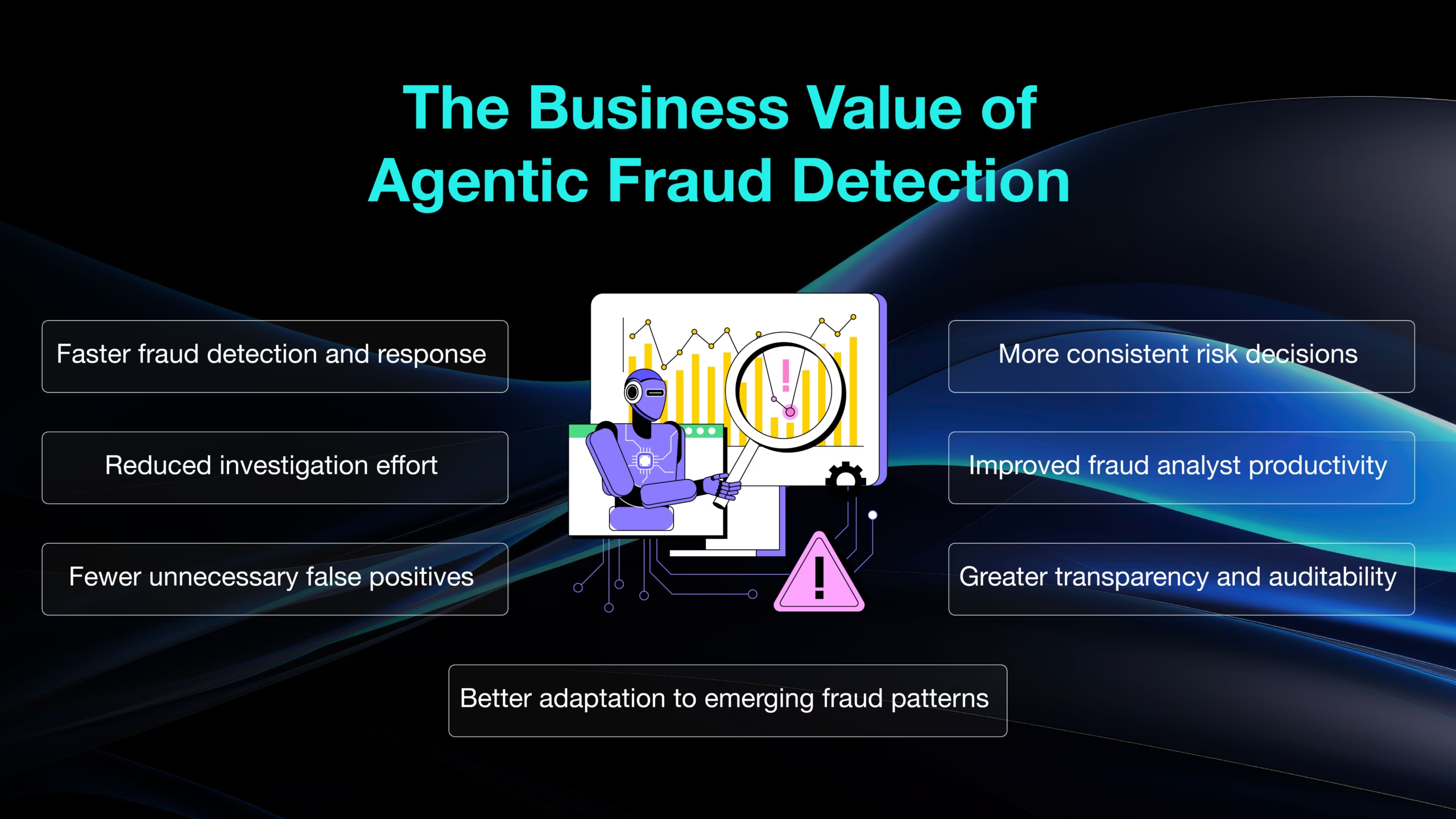
By combining real-time data, machine learning, behavioral intelligence, specialized AI agents, explainable risk scoring, and human oversight, financial institutions can move toward fraud operations that are more responsive, contextual, and adaptive.
The future of fraud detection isn’t simply about finding the suspicious transaction.
It’s about understanding the story behind it, and acting before that story becomes a loss.
At Cognine Technologies, we help organizations explore and implement AI-driven approaches that bring intelligence into complex business processes, from decision support and intelligent automation to enterprise AI solutions.
As financial institutions face increasingly sophisticated fraud risks, Agentic AI can play an important role in building more intelligent and responsive risk operations.
The question is no longer whether AI can detect fraud.
The next question is: how intelligently can it investigate, reason, and respond?